
Last Tuesday I stood in my kitchen for a full four minutes fighting a jar of pasta sauce. I tried a dish towel. I tried hot water. I tried tapping the lid on the counter, which mostly just made noise. By minute three I was genuinely angry at a jar.
That is the thing about frustration. It rarely matches the size of the moment. The jar was never the problem. The problem was that I was hungry, the day had been long, and dinner was the one simple thing I wanted to go right.
Frustration is like that. It shows up loud and points at whatever is closest, but the message underneath is usually about something deeper. Here are seven things it might be trying to tell you.
1. Something here matters to you
We do not get frustrated about things we do not care about. You never rage at a jar of sauce you did not plan to eat. Frustration is proof of investment. When you feel it rising, pause and ask what you care about in this moment. The answer is usually worth knowing.
2. Your approach might need adjusting
Sometimes you are pushing hard in the wrong direction. More force on a stuck lid just tires your hands. Frustration often means the strategy is stale, while your effort is fine. Try one small change to the method before you question your ability.
3. You might be running on empty
Low sleep, a skipped lunch, a week with no real break. An empty tank makes every bump feel like a wall. Before you decide the situation is impossible, check the basics. A glass of water and ten quiet minutes have resolved more frustration than most of us want to admit.
4. A boundary of yours just got crossed
Last spring, a neighbor started borrowing my ladder without asking. The first time, I laughed it off. The third time, I found myself snapping at my kids over spilled juice, which had nothing to do with the ladder at all. Frustration often arrives wearing a disguise. It points at the juice, or the traffic, or the slow WiFi, when the real message is that a line got crossed somewhere and never got named. When your reaction feels bigger than the moment, look sideways. The boundary that needs your attention is usually standing right next to the thing you are upset about.
5. You are closer than you think
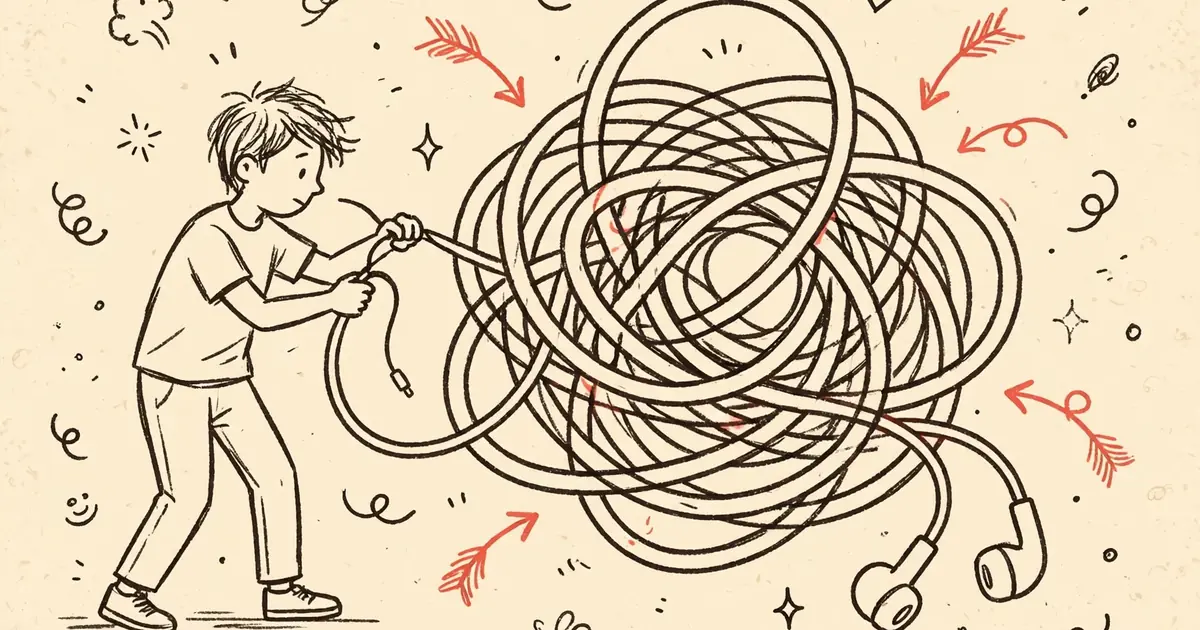
Frustration loves to visit right before the breakthrough. The knot is always tightest just before it loosens. If you have been working at something that matters, this feeling might be a sign of real progress through the messy middle. Keep going, gently.
6. It is okay to ask for help
Frustration sometimes means you have been carrying something alone that was never meant to be solo work. Asking for help is one of the bravest moves you can make. Tangled cords come undone fastest with a second pair of hands. The people who care about you would rather lend a hand than watch you wrestle.
7. This one might be yours to release
Some frustrations are signals. Others are just noise you picked up along the way. If you have adjusted the approach, rested, checked your boundaries, and asked for help, and the feeling is still there, consider setting it down. Not every knot needs untying. Some cords can simply be put away.
Try this: the Work with Frustration Pathway
If frustration keeps visiting you, the Lantern Project has a full guided page for it: Work with Frustration. It helps you slow your reaction when something important feels blocked, so you can choose your next move with care instead of heat. Think of it as the calm friend who talks you down from the jar lid moment and helps you decide what truly deserves your energy.
The next time frustration flares, try listening before reacting. It might be telling you exactly what you need to hear. And if you would like more gentle tools like this one, wander through the Lantern Project a little. It is free, it is warm, and it meets you exactly where you are.